Why AI agents may need a purpose-state before they act.
Agents are becoming more capable. They write code, call tools, update records, open pull requests, and trigger workflows. But capability is not the same as reliability.
A prompt tells an agent what to do. A purpose-state tells it what must remain true while doing it.
A personal thought experiment on agent reliability. Not a product. Not conscious AI.
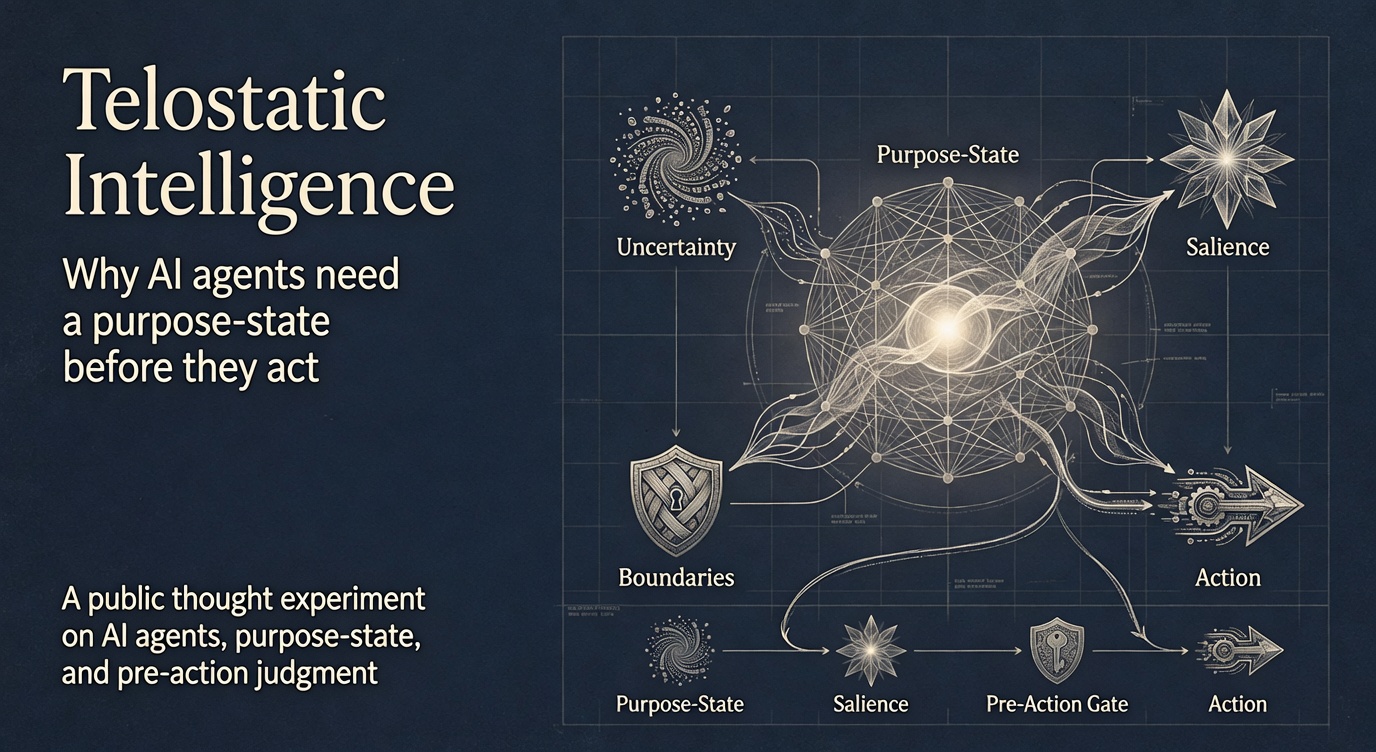
Text is forgiving. Side effects are not.
A hallucinated paragraph is one kind of failure.
A hallucinated database migration, payment-code change, refund approval, customer email, or production command is a different category of risk.
As agents move from answering to acting, the trust model changes.
It is no longer enough to ask whether the agent can complete the task. We also need to ask: should this agent take this action, in this state, with this uncertainty, and this blast radius?
That question cannot live only inside the prompt. It needs to live before the action.
A goal is thin. A purpose-state is thicker.
Fix the checkout bug.
Fix the checkout bug — without changing payment logic, without breaking guest checkout, and with a clean rollback path if this goes sideways.
Many agent failures are not failures of intelligence. They are failures of boundary. The agent fixes the test but breaks the product. It completes the workflow but ignores policy. It answers the user but hides uncertainty.
What does “telostatic” mean?
telos — purpose, end, direction.
-static — borrowed from homeostasis, the maintenance of stability under changing conditions.
Telostatic: maintaining a purpose-state under changing conditions.
A telostatic agent is not conscious. It does not have a soul. It does not preserve itself. It preserves the assignment.
The telostatic loop
- step 01Purpose-state
- step 02Self-state
- step 03World-state
- step 04Salience
- step 05Pre-action gate
- step 06Action / Escalation
- step 07Feedback
- step 08Updated purpose-state
The shift is from action as output to action as a gated transition between states.
Try the Purpose-State Checker.
Enter a proposed agent action. The checker returns a purpose-state packet: what the agent is preserving, what it assumes, what is uncertain, the blast radius, and whether it should proceed, pause, escalate, or stop.
Launch the checker →Not conscious AI.
Telostatic Intelligence is not a claim about sentience, subjective experience, or machine rights. It is a practical framing: if agents are going to act in the world, they need a running model of what their actions must preserve.
No ghost. No soul. No self-preservation. Just a governor around purpose.